One of the terrible jokes I remember from my childhood involves a nearsighted old lady who walks into a pet shop by mistake for a kitchen store, and asks to buy an infra-red griller. The pet shop salesman replies solemnly that they are out of stock on those, but he can offer her an ultraviolet chimpanzee...
So, why grillers? Well, in March, after more than a year of peregrinage, we finally moved to our new flat in Edinburgh. This meant a tremendous amount of sorting, discarding, packing, transporting and unpacking, including deciding what from the kitchen should come with us and what should really have been thrown out years ago.
It also meant a new kitchen. The new kitchen is equipped with a fridge that is less than half the size of our previous one, a range hood and exhaust fan neither of which work properly, and the induction stove from hell. The combination of the latter two factors resulted, the first dozen times I tried to cook bacon, in the flat filling with smoke and the alarm going off. Worse still, none of my large pots, deep skillets or my wok would work on the stove.
The net effect of this has been that my cooking has changed considerably. Stir-fries are right out; simmering anything on low heat is a dubious prospect, to say nothing of the pan size problem, so stews and curries are likewise off the menu. In place of these, however, the oven and griller (infrared or otherwise) are getting a good workout, as a way of putting a nice browning on things without burning them to all hell and causing the fire brigade to come. Roasted vegetables tossed with some sort of dressing are pretty much my go-to weeknight dinner, when it's just me.
Of course, it usually isn't just me, and most people don't share my love of roasted broccoli and brussels sprouts. So how does one entertain, when one's usual methods of cooking and repertoire of dishes have gone out the window? Clearly, one invents a new dish, and then proceeds to make it Every Single Time people come over. I estimate I've cooked this every week for the last month, but when it's so easy and delicious, it's hard to stop! The sweet-tart juices of the grilled tomatoes contribute to a natural dressing for the slightly-charred beans, contrasting with the salty feta and the fresh mint, with some crunch from the toasted almonds, and the whole thing comes together in less than 10 minutes. Plus it looks great with all the contrasting colours, textures and shapes. You can't do that with an ultraviolet chimpanzee...
Grilled green bean, tomato, feta and mint salad
1 packet (200g?) green beans, top'n'tailed
1 packet (200g?) cherry tomatoes
olive oil, salt, pepper
zest and juice of a lemon
balsamic syrup (optional)
good handful fresh mint, chopped
50 g feta cheese, crumbled
small handful roasted almonds, chopped
Heat up the grill (broiler, if you're American). Spread the beans on a tray, throw the tomatoes on top, drizzle with olive oil, and toss with salt and freshly ground black pepper. Place under the grill for a few minutes, until the vegetables begin to brown and char on one side. Turn so the brown bits are down and grill for a couple more minutes, until beans are cooked and the tomatoes are just popping their skins. Transfer to a plate, season with more pepper, zest the lemon over the pile and squeeze the juice on top, drizzle with more good olive oil and balsamic syrup (adds more depth to the sweet-tart flavour, but if you're Lee and don't like vinegar, it can be left out), scatter the mint and feta on top, give it a light toss to combine those flavours and then finish with roasted almonds. Done making!
Thursday, 31 August 2017

Saturday, 22 October 2016
Bottomless Brunch, DC style

One of the institutions I quickly got on board with while living in DC was weekend brunch. Many places offer excellent "bottomless" deals, whereby you pay a fixed price for the joy of being able to linger over brunch for hours, nibbling at little plates of deliciousness and sipping interesting drinks. I quickly got into a routine of working for a few hours in the morning, then taking my laptop out for a brunch date and a couple more hours of writing, followed by a stroll round a gallery or park while digesting -- or sometimes just back home for a nap!
 One of the places I enjoyed was Masa 14, not far from me on 14th just south of U St. The combination of outdoor deck on a still-sunny autumn day, tasty small plates featuring fusion flavours, and a great selection of Asian-inspired cocktails, was just what I needed to finish the paper I was working on!
I didn't order this pork belly and spicy slaw pressed sandwich, but it was very delicious nonetheless.

A couple of bites of sushi roll and a florentine-style egg with mushrooms, together with a lemony lager cocktail -- surprisingly good!

Smoked salmon salad and a lychee bellini.

Roasted cauliflower is always delicious; the steamed bun was also very good. I didn't order the plantain either; it just arrived. A banana by any other name...

Monday, 10 October 2016
Underground, Overground: a visit to Toki

Toki Underground is high on the DC food scene hotlist, but over on the NE side it's a bit out of my usual territory. Arriving into Union Station after a trip to Baltimore, though, I headed up to Union Market and found it closed, and by then I was far enough over that a trip across to 12th St NE was only a few more blocks.

I arrived about 4:30 (opening time is 5pm) so stopped in the pub, or rather The Pug, next door. Despite the name, Toki Underground is actually upstairs -- I expected it to be in the basement!

While waiting I read a few reviews and realised it was just as well I was early, since this place is insanely popular. Some of the reviews mentioned a line forming outside prior to opening! This being a Monday it must have been a bit quieter; no line but when I headed up at 5:15 the place was already filling up.

The bar top features quirky pachinko decor, while cocktails are mixed right in front of you.

This take on an Old-Fashioned, the Toki Monster, featured a little garnish of candied, char-grilled butabara.

These gyoza in a tangy soy glaze were toothsome and tasty.

I opted for the kimchi ramen, which were surprisingly spicy with a rich, creamy broth.
I may not be in Japan any more, but I can still eat ramen!
Wednesday, 5 October 2016
No cow tipping - Thip Khao

I've heard that cow tipping is a bizarre sport which involves going into fields and tipping cows over on their sides; apparently the cow can't get up on its own and just has to lie there in the field. Having learned about this I then wondered about fly tipping, which it turns out isn't pushing flies over onto their sides. And then there was the lobster tip incident in Santa Cruz...
Anyway, there were no lobsters, cows or flies in evidence when I visited Thip Khao, a Cambodian restaurant up in the Columbia / Petworth strip that gets gongs on the DC food Internet scene.

Dining solo can be difficult when you want to try everything! The portion sizes here are sufficiently modest (and the waiter's advice on that and heat level was spot-on) that I had room for a duck larb salad and an eggplant and hot-pepper stew with snakehead. Both dishes were packed with flavour, the larb seasoned just right with great texture from the roasted rice, and the stew almost like a tangy, zesty, soupy, roasted eggplant purée with tender fish pieces and a soft egg nestled in.

I did eat only one of the compact little packs of sticky black rice that came with each dish, though.
Monday, 25 July 2016
When in the US...
There are a few things the US is famous for and one of those is burger chains. On a scorching day I headed downtown to get a bikeshare key and, having succeeded in my mission, decided a burger was in order for lunch.
Shake Shack has a branch on F and 9th, not far from L'Enfant where the bike van was stationed, so I headed up there. After wrestling with the bike return in the heat I was exhausted and had to sit on the windowsill gulping water for about 10 minutes before I felt able to order!

I felt I ought to do justice to the place by ordering the classic and a shake (the Black and White). The burger was pretty tasty, though I would have liked the vegie version more; fries were good and sauces free-flowing, always a plus. The shake was rich and sweet and filling; I discovered later that this combo contains more calories than I need per day which explains why I didn't want any dinner later on!
Verdict: good burger, would have the vegie next time and skip the shake
Wednesday, 27 January 2016
Pull-price bonanza! Discount time at the Japanese supermarket
The fun multiplies exponentially, though, when not only do you not know what half the products are, nor what or how they are to be cooked or used, but you can't even try to read the directions to figure it out! Let's just say that going to the supermarket instantly became one of my favourite activities on arriving in Japan. Through a combination of practical experimentation (eat it and see), internet research and language learning, I am gradually demystifying the secrets of Life (that's the name of my local supermarket). But there are so many things still to try!
 Another pleasing feature of Japanese supermarkets is that, because
there's a lot of emphasis on freshness (most Japanese people go food
shopping every couple of days, rather than once a week, and buy things
just to eat that day or the next), there are a lot of products with
limited shelf life -- and hence, at the end of the day, a lot of about-to-expire-by-tomorrow products reduced to clear. At home we call this "Whoops!" food, after Asda's reduced-to-clear labelling system; here, one of the first few characters I learned to read was 引, because it appears on a lot of doors: "pull". So, Pull-price time: usually from about 5pm at Life.
Another pleasing feature of Japanese supermarkets is that, because
there's a lot of emphasis on freshness (most Japanese people go food
shopping every couple of days, rather than once a week, and buy things
just to eat that day or the next), there are a lot of products with
limited shelf life -- and hence, at the end of the day, a lot of about-to-expire-by-tomorrow products reduced to clear. At home we call this "Whoops!" food, after Asda's reduced-to-clear labelling system; here, one of the first few characters I learned to read was 引, because it appears on a lot of doors: "pull". So, Pull-price time: usually from about 5pm at Life. 
What's even more exciting than getting a delicious and varied dinner for just over half-price, though, is that I can now recognise all of the kanji in the names of each dish! But, and this illustrates the complexity and the difficulty of learning to read Japanese, that doesn't necessarily mean I understand what they are, or would be able to ask for them in a restaurant, that is, know how to say them. Let's take a look and see how this works.
Clockwise from top left, we have:
かに 風 味 サラダ 少量
This is probably my best one for reading, as I know the meaning and the pronunciation of all the characters -- and yet I still got it kind of wrong. The first two hiragana are "ka-ni", that means crab; the next one means wind, which on its own is "kaze"; then taste, "aji"; then the katakana (used to 'spell' foreign words, and hence often recognisable as words from sounding them out -- provided the loan language is English, of course!) are "sa-ra-da", salad. The last two just mean little and quantity. So, crab wind-taste(?) salad, small-size: "kani kaze aji sarada"? Except that when you put "kani" and "kaze" together they become another word that itself means taste, or flavour, and is pronounced "fuumi". Obviously.
九州産ほうれん草のごま和え
Ok, actually I'm pretty good with this one, but more through knowledge of Japanese food than reading ability. Individually, we have nine ("kyu") - state - product - "ho-u-re-n" - grass - "no" (a particle that indicates possession and also does about a million other things, most of which I don't understand) - "go-ma" - harmony - "e". I happen to know, though, that nine-state is how Kyushu, the southernmost main island of Japan, is written; I also discovered the dish known as "horenso no goma ae", spinach with sesame dressing, at my first-ever Japanese restaurant experience, and have loved it ever since. "Kyushu horensou no goma ae" it is, then.
ずいきの酢の物
These were one of the first mystery foods I tried from the supermarket deli section, and after trying them, I was still none the wiser as to how to identify them, except as "some sort of delicious pickle". A more experienced friend was able to enlighten me: apparently they are taro stems. Now, however, I can also read the name: "zu-i-ki" no vinegar no thing. Here again my general knowledge of Japanese food helps me as much as my rudimentary knowledge of Japanese language: I know that thing is often "koto", "mono" or sometimes "ji"; I also know that a style of lightly-vinegared cold dish is called "sunomono". Sure enough this is "zuiki no sunomono", and via Google I discover an interesting story about why taro stems are called "zuiki", meaning to weep for joy. They are very delicious!
豆腐 ハンバーグ きのこあんかけ
I've seen these on pull-price before and not bought them; the first time I peered at them, unable to read the packaging, I thought they were some kind of chicken patty. However! The first character I've recently learned (number 1548 in the Heisig RTK 2200, 75% through!) as bean; the second is rot. I know, though, from seeing them together in more recognisable contexts, that bean-rot means tofu. (Incidentally the Japanese pronunciation is tou-fu. Tofu, 渡仏 [transit-Buddha] means "to go to France". Yes, they have a specific verb for that. What?) Then we have, in katakana, "ha-n-baa-gu", hamburger; and "ki-no-ko-a-n-ka-ke". I know that "kinoko" is a sort of soy bean powder used as seasoned coating, and a bit of Googling tells me that "ankake" is a style of cooking meaning food cooked in a thick starchy sauce. Indeed, not chicken patties at all: these are tofu hamburgers with kinoko, doused in a potato-starch thickened savoury sauce, and very tasty too. I will be buying these again.
伏見唐辛子土佐煮
This is probably the clearest example of how knowing kanji often doesn't help you to read at all! I know every single one of these characters from Heisig and yet have no idea what this says: prostrated-see-T'ang-spicy-child-soil-assistant-boil. Some work with Jisho reveals that prostrated-see is how you write the place name Fushimi, and a T'ang-spicy-child is a capsicum or hot pepper, pronounced "togarashi" (aha! as in shichimi togarashi). Soil-assistant seems to be pronounced "Tosa" but can refer to a number of different things, mostly place names, none of which seem to be particularly associated with boiling ("ni"). So this is Fushimi-togarashi-tosa-ni, but I'm not sure what the last part actually means!
So, there you go. Adventures in food, culture and language, and all at 値引き後価格, price-pull-ki-behind-value-status: "nebiki go kakaku". It's Japanese for Whoops.
Thursday, 24 December 2015
Oden adventure
The first time I tried oden was in the Hama-Rikyu Teien garden in Tokyo, nearly two years ago. It was a cold winter's day, and although I hadn't long ago eaten an exquisite sushi lunch at the Tsukiji Fish Market, the scent of simmering broth filled with daikon, konnyaku, fishcakes and other goodies was too good to resist. I ate it with hot mustard from a sachet, accompanied by a cup of sweet, milky ama-zake, and it was delicious.
It's perfect oden weather here now: cold and a bit misty. So as I was browsing the refrigerator section at the supermarket and marvelling at the array of fishcakes, tofu and other tasty fried things, I decided to make oden as my first Japanese-cooking-in-Japan project. Although it takes a while to cook, simmering for at least 45 minutes to get the daikon nice and soft, and then for the best results, being cooled and then reheated so that the flavours blend, it's simple to make. The broth doesn't require a lot of ingredients, just seasoned dashi, and then you throw everything in and just let it cook.
Here's what I put in mine:
I also put in some eggs. Everyone knows what an egg looks like, right?
The recipe is so simple it's not even really a recipe: put about a litre of water in a pan, bring to boil. Meanwhile prepare daikon and kabocha. When the water is just boiling, add a packet of powdered dashi, about 3tbs of soy and 2tbs of mirin (to taste). I also added some prepared ginger (shoga) from a tube -- this is totally unauthentic as I haven't seen it in any traditional recipes, but I love ginger and I think the flavour goes together well. Put in all the other goodies, cut into appropriate-sized pieces, and simmer for about an hour, or until the daikon is soft. While this is happening, cook the eggs until just boiled (either in the broth, or I did them in my hot-water boiler for the easiest boiled eggs ever) then cool and peel. Take off the heat and leave to cool; steep the cooled boiled eggs in some broth as well.
Next day heat up, throw some chopped spring onions over the top (also not really authentic but I like them) and serve with a squeeze of hot "karashi" mustard.
My Japanese workmates were well impressed when I brought this for my lunch the next day!
It's perfect oden weather here now: cold and a bit misty. So as I was browsing the refrigerator section at the supermarket and marvelling at the array of fishcakes, tofu and other tasty fried things, I decided to make oden as my first Japanese-cooking-in-Japan project. Although it takes a while to cook, simmering for at least 45 minutes to get the daikon nice and soft, and then for the best results, being cooled and then reheated so that the flavours blend, it's simple to make. The broth doesn't require a lot of ingredients, just seasoned dashi, and then you throw everything in and just let it cook.
 |
-daikon radish, peeled and cut into largish chunks |
Here's what I put in mine:
 |
| kabocha, skin on but seeds removed, in thick slices |
 |
| tubular fishcakes, or "chikuwa" |
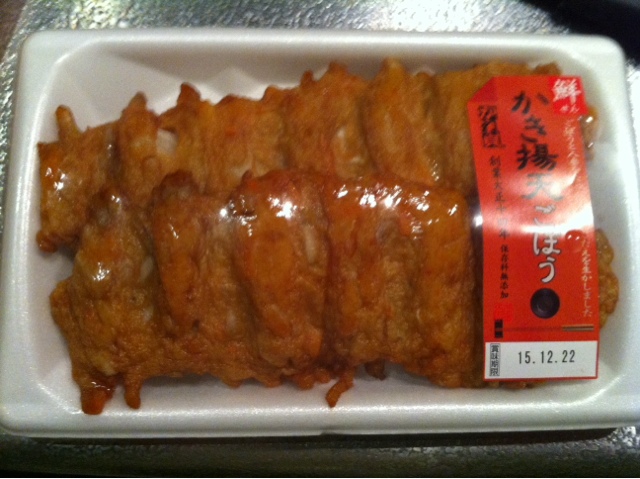 |
| kakiage, sort of like a fried vegetable cake - I chose the ones with burdock, or "gobou" |
 |
| oops, these are upside down in the photo. They're a kind of fishcake but all I can read is "white-something-fish-age". |
 |
| Kyo-age, a deep-fried tofu sheet that is a Kyoto specialty |
 |
| forgot to take a picture of my konnyaku twists, but here's the rest in its packet |
The recipe is so simple it's not even really a recipe: put about a litre of water in a pan, bring to boil. Meanwhile prepare daikon and kabocha. When the water is just boiling, add a packet of powdered dashi, about 3tbs of soy and 2tbs of mirin (to taste). I also added some prepared ginger (shoga) from a tube -- this is totally unauthentic as I haven't seen it in any traditional recipes, but I love ginger and I think the flavour goes together well. Put in all the other goodies, cut into appropriate-sized pieces, and simmer for about an hour, or until the daikon is soft. While this is happening, cook the eggs until just boiled (either in the broth, or I did them in my hot-water boiler for the easiest boiled eggs ever) then cool and peel. Take off the heat and leave to cool; steep the cooled boiled eggs in some broth as well.
 | |||
| Ready to heat and eat! |
Next day heat up, throw some chopped spring onions over the top (also not really authentic but I like them) and serve with a squeeze of hot "karashi" mustard.
My Japanese workmates were well impressed when I brought this for my lunch the next day!
Subscribe to:
Posts (Atom)