Monday, 24 March 2014

Nasu dengaku (sort of)

Yet another way to eat my most-beloved vegetable, nasu dengaku is a Japanese dish featuring aubergines halved lengthwise, grilled over coals and brushed with a miso glaze. The contrast between soft flesh and charred, bubbling glaze, sweet and salt in the miso and rich flavour of the aubergine makes for a perfect combination that brings out the best of the vegetable.

My version cheats and cooks the eggplant under the oven grill; it doesn't have quite the same charcoal-fired smokiness but still tastes good and is super-easy.

Glaze:
2 tbs white miso paste
3 tbs sake
2 tbs sugar
2 tsp light soy sauce
(optional: 1/2 tsp grated ginger; 1/2 tsp grated garlic)

Halve two medium aubergines lengthwise and place under grill heated to maximum. cut sides down, until skin is hardened and puffed and flesh begins to soften (about 10 min). Turn over, slice diamond patterns into flesh of cut sides and spoon glaze over. Grill until flesh is soft and glaze begins to bubble and develop charred spots (about another 5 min), watching carefully to make sure glaze does not burn. Sprinkle with sesame seeds and sliced green onions and serve with steamed rice.


Friday, 10 January 2014

Playing Peter Piper

We didn't host Christmas this year, so there was no what-to-do-with-turkey-leftovers problem before New Year -- not that this is much of a problem; a few rounds of sandwiches, a pasta sauce or two, and a giant vat of stock to deal with the bones usually sorts it nicely.  As a combined result of going away just after New Year and having lived on pretty much nothing but mince pies, stollen, Stilton and sherry in the week after Christmas, however, I did have the problem of a fridge full of vegetables that would long be green slime before I got back to use them.  What to do?  Sweet potatoes and a couple of carrots became soup; potatoes became stuffed potatoes and stored in the freezer for future snack emergencies...

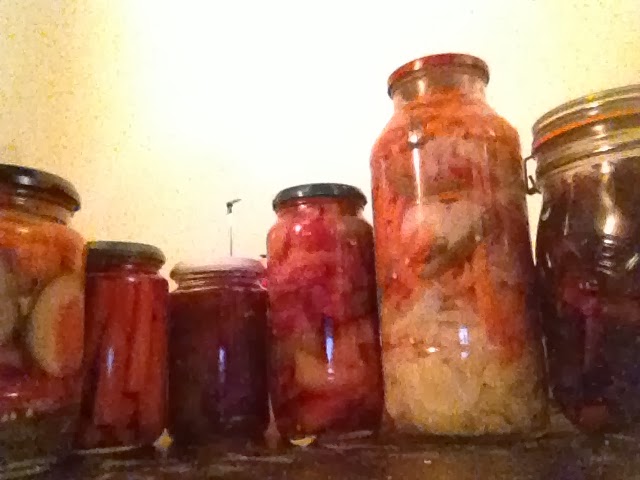
... and red cabbage, white cabbage, still more carrots, half a cucumber, two capsicums, red chillies, green chillies, onions and an entire swede became a diverse array of different pickles!


The "pickle everything in the fridge before going away" has worked reasonably well for me once before, but this time I wanted to make sure they would last a while since even with my love of pickled things, it might take me some time to get through this quantity.  Recipes often emphasise the importance of sticking to the correct quantities of known-acidity vinegar and salt in order to preserve pickles safely, but frustratingly don't always provide a generalised guide as to what the proportions should be.

I found one recipe specifying a 1:1 mixture of 5% vinegar and brine (made with 1 cup salt per gallon of water) for final concentrations (before allowing for vegetables releasing liquid) of 2.5% vinegar and about 1/8 cup salt per litre; and another saying "6 cups of water, 3 cups of vinegar and 1/2 [presumably 1/2 a cup] pickling salt", which is slightly under 1/4 cup salt per litre.  Not knowing the concentration of my vinegar, I decided at first to go for a 2:1 rice vinegar:water mix with a scant 3tbs salt in 3 cups of liquid (the salt ratio of the second recipe).  I blanched the red cabbage for a few minutes and used the water in the pickling liquid, which I simmered with star anise, peppercorns and cloves -- but on tasting, it was WAY too salty!  I added another 1/2 cup each of water and malt vinegar and 3/4 cup sugar; it was still on the salty side but better.  Half a head of red cabbage made the large jar shown at right.  I suspect when using it I may rinse it, or use it in dishes without added salt, or mix it with fresh in order to dilute the saltiness.

The leftover red cabbage pickling liquid was a deep purple colour, so I thought I'd make some pickled carrots (I had a LOT of carrots; the 1.5kg bags were 69p the week before Christmas) -- second from left.  I cut them into sticks in order to squeeze as many into the jar as possible, and then simmered them in the pickling liquid for about five minutes before bottling.  Next up were a couple of bottles of mixed vegetable (cucumber, carrot and chilli; and cabbage, carrot and chilli), using rice vinegar and ginger; and then the pickled peppers, with most of the red and green chillies, yellow and green capsicum, and some sliced red onions.  There was enough pickling liquid left for a jar of pickled red onions with stray chilli bits too.

That still left the swede.  Now, swedes are fairly dense and hard, so I thought that shaving them into thin slices with my peeler-slicer would be a good start.  Then I got thinking about thinly sliced other sorts of pickles, like radish, and the next thing that came to mind: kimchi!  A bit of googling revealed that turnip was a fairly common kimchi choice, and that virtually anything could be kim-chied.  The first step was to peel the swede, cut it into manageable sections and then slice into fine cross-sections.  These were sprinkled with 2-3tbs salt and mixed thoroughly then left to stand for a few hours.  Some recipes say rinse, others don't (and vary the salt accordingly -- 2tbs salt to about 2lbs vegetables was a common don't-rinse proportion); I went for a compromise of rinsing once in a measured amount of water (3 cups, which would result in a brine as concentrated as that recommended by the second pickling recipe) and then draining thoroughly.  A taste test indicated not too salty, not too bland.

For the rest of the mix, opinions were divided on the effectiveness and authenticity of using gochujang (chilli paste) rather than gochugaru (chilli powder) but the former was what I had, in exactly the right quantity to use up for this size batch -- about 1/4 cup.  Following another recipe, I blended up half a red onion and half an apple; garlic is also usual and the importance of ginger is stressed, but I had none left of either so I threw in a few scoops of pickled ginger instead, and a slosh of vinegar.  Mixed all together, this looked like a promising start to kimchi and tasted pretty good as well.

I packed the mix into a couple of jars, pushing it down tightly -- I think this is to remove air spaces and allow the anaerobic fermentation to take place.  Apparently after that kimchi just looks after itself, usually at room temperature for a day or two to begin fermentation before cold storage for a week or two, but I put mine straight in the fridge as I was going to be away and had visions of it coming to life and escaping.  I left the lids on loosely to allow some room for fermentation -- if it expands too much, at least the jars are sat in the (now empty) crisper drawer and won't overflow everywhere!  We'll see what it's like in a few weeks' time...

Wednesday, 8 January 2014

Wolcum alle another yere!

Another year (or yere, as the Middle English text made famous by Benjamin Britten would have it), another chance to reflect ruefully on my failure to blog as much as I'd like... Despite my resolution of last year to achieve one new food-related experience and one blog post each week, in 2013 I managed just 18 posts. But at least I can say with certainty that this wasn't due to a lack of new experiences; rather, I was too busy having the experiences to blog about them! Where things really went to pot (cooking pun slightly intended) was in May, when fairly massive work commitments came to an absolute crunch (why is crunch such a savoury, delightful description for food but such a horrible term in the context of crunch-time? Personally I think crunch-time ought to refer to that blessed hour of the day when it is acceptable to break out the wine and crisps) and I barely got everything done the day before heading off to Ecuador for two months.

Ecuador was full of memorable and interesting food experiences -- some for better reasons than others: Chef Olga's fried dough balls will stay with me for a long time, in fact I think I can still feel them sitting in my stomach now. And though her arroz con menestra was quite tasty, there's only so much rice and beans one can eat before it becomes tedious. Then there were the chuntacurrus: marinated, deep-fried grubs with a horny head, a tough leathery skin and squooshy innards. Although not terrible, they still fall into the category of 'things I can say I've eaten' rather than 'things I'm glad I ate'.

On the other hand: I had some truly superb seafood while staying in Puerto Ayora in the Galapagos, including a fabulous juicy, sweet and tender grilled lobster with accompaniments for $25; a very tasty encocado de camaron in a lush coconut sauce; a great mixed seafood grill; and an utterly delicious dish of sea snail in garlic sauce, all from the seafood shacks along Charles Binford Avenue. There was also the freshest of fish straight off the boats, filleted and cooked right at the dock (with sea lions and pelicans waiting to snatch up the scraps); and the enticingly fragrant caldo de bolas de verde, too hearty to be a mere soup, rich with peanuts and spices, spiked with lime and with a generously sized tender plaintain dumpling stuffed with meltingly stewed goat in savoury sauce.  And I became quite a fan of the $4 almuerzos and meriendas, including a soup, juice and choice of daily dishes -- not gourmet but good homely fare, and both cheap and comforting in my temporary home. The Ecuadorian range of hot sauces also has to be seen (or perhaps tasted) to be believed! I was in heaven at the supermarket and tried to buy one of everything; after two weeks of thirty people sprinkling them lavishly over Olga's rice and beans, we had just about exhausted the supply.

Anyway, once I got back it was off for September's pre-semester conference round and then straight back into being buried in work. Leisure to blog was hard to come by and with so many weeks of posts unposted, it seemed in vain to try to catch up. I do have quite an archive of notes and photos awaiting write-up, though, so I haven't been entirely stagnant in the fooding aspect of my life. Maybe 2014 will be a chance to get more of my thoughts and ideas and memories down in blog form. Here's hoping!

Wednesday, 18 December 2013

Tinned Tomato Taste Test

My local preferred supermarket sells two varieties of tinned tomatoes, and neither of them are San Marzano, which I understand to be the brand-of-choice for today's foodie. Instead, they come in ordinary and premium types. The latter has a more gourmet-looking label and costs 46p (or 39p on special) instead of 31p. But is it worth the extra 15p?

A monster chilli cooking session provided the opportunity for a comparison: I bought four tins of each type, thinking to smooth out any quality-related difference in the finished product by combining them. (A real test would have been to make two separate batches, one with each kind, but I had neither the time nor inclination nor kitchen facilities for that!)
The premium chunky chopped look a bit more rugged when the tin is opened; the regular kind have lots of smooth juice, though it's not too thin.

Emptying each tin into a bowl shows the textural difference; interestingly the regular has a deeper red colour than the premium.

But the real difference is in the taste: comparing a spoonful of each, the regular tomatoes taste weak and slightly acidic compared to the rich, round flavour of the premium kind. For around 30p more per average pot of tomatoey-saucey thing, it seems worth the extra. Then again, given the cheapness of tinned tomatoes, 15p represents a 50% price increase. If the tomato flavour is the star and needs to shine through, I expect the premium would be the better pick. But if the dish is going to be loaded with other flavours and spiked with additional tomato paste, maybe it wouldn't be especially noticeable. Perhaps I do need to do that double-batch taste test after all...!


Saturday, 16 November 2013

Eating Bruges

Well, it's November, week 46, nearly the end of the year and I have no idea how far behind I am with my New Year's one-post-one-new-thing-a-week resolution. Although posts have been sadly lacking over recent months, one of the reasons is that I've been away for a lot of that time and hence having lots of new food (and other) experiences, even if failing to write about them!

Right now, as it happens, I'm in Bruges for a day or so. Work takes me to Brussels more often than any other Continental city, and I do like it there (dinner in Little Vietnam is always a highlight, and the bars and cafes around Grand-Place for the proper tourist experience, or the back streets of Ste Catherine for funky chill-out drinking venues) but I feel like I've 'done it' enough, whereas Bruges is renowned for being historic and picturesque and is only an hour by frequent train from Brussels, and yet until now I'd never been. An evening and a day is only enough (especially when one spends half of that time working on a paper for deadline) to get a taste of the atmosphere, wander around and see a few sights -- but also enough to sample some of the city's dining and drinking spots.

I arrived at Bruges station around 4:30; dusk was just falling by the time I reached the town centre, so after finding my hostel and checking in, I decided a drink in the hostel bar was in order. They serve a decent house beer, Augustin, which seemed like a good place to start a Bruges beer adventure; I also tried a Keiser Karel. I know next to nothing about beers and can't even say what type these were, but both were rich, full-bodied and long-tasting.

Two beers down, I was getting quite hungry and ventured out in search of dinner. After getting distracted by the night-time canal-side scenery and meandering through a few back streets, I ended up back at a little place just across the road from the hostel. De Gouden Kroes is a seafood restaurant that comes reasonably well-recommended on TripAdvisor, which in this city that seems to have more restaurants than residents (I'm sure 90% of the people I've seen have been tourists) is as good as any other way to choose -- that and the €35 seafood platter, which when one is trying to decide between oysters, mussels and other options, provides a perfect compromise. I was slightly surprised that they were entirely empty at 7:30 on a Friday night, but this didn't detract too much; the atmosphere was neat and clean, and the huge tank of live seafood on display inside the restaurant promised good things.


Complementary appetisers consisting of a dish each of green olives, little brown-grey soft-shell shrimp and winkles (complete with pin for winkling) were very welcome, even if the inclusion of the latter also on the seafood platter made them a tad redundant. The platter itself was enormous, excellent quality and very good value. Three types of oyster (I'm afraid I don't remember which, though they were all subtly different and deliciously fresh); a generous helping of mussels and a similar number of large whelks, both steamed; a pot each of crevettes and winkles; three big, juicy prawns; two edible crab claws and two lusciously meaty spider crab claws; two langoustines complete with spiky claws and sweet, springy tail meat; and a huge whole scallop, together with a dish of thinly sliced scallop meat (possibly again different types; I didn't ask, but they seemed different - though that may have been due to the different presentation), both raw and with a wonderful sea-fresh sweetness. A choice of sauces came alongside: shallot vinegar, mayonnaise, aioli and a lightly spiced rouille; and the Muscadet available by the half-bottle was a perfect accompaniment.


The next morning, I needed to find somewhere for a tea-fueled writing session. (Not only did I want to get out and see somewhere other than the hostel cafe, but the frankly unenthusiastic service of the morning staff didn't induce me to stay!) Gingerbread Cafe, on Sint-Amaand St, fit the bill well: a spicy lemon black tea, and then a praline-scented black tea with hazelnut and almond, were both suitably aromatic and invigorating, and came with free hot water refills and a little chocolate and friand to nibble. I didn't feel up to cake for breakfast but picked up some ginger cake to take home.


Deadline met, I was ready for a late lunch around 2pm. Following my Lonely Planet mini-guide, I decided to head to Cafedraal, near the massive St Salvador's Cathedral, so I could see a bit more of the city en route. While I felt the welcome from the front of house was rather snooty ("A table? Well, just one dish and order quickly, the kitchen closes at 3..."), my at-table waitress was lovely, recommending which beer would go with my food (something called Bruges-Zot, with a nice rounded bitterness) and being all-round smiley and nice. The food itself was also excellent: I defied the maitre d' and ordered two dishes, though I did concede they could come at the same time -- a half-dozen oysters, and a "North Sea fish soup". The oysters were plump and everything one could want an oyster to be (save for detached-from-their-lower-shells, which I had to attempt myself with the oyster fork); the soup was outstanding. Tender chunks of salmon and whitefish, mussels and a fat prawn swam in a rich, tomatoey broth laden with finely diced vegetables. Little croutons, spread with a rouille that was piquant rather than creamy and sprinkled with shredded cheese, acquired a perfect texture and savouriness from bathing in the soup. Though listed under starters, this was easily hearty enough to be a main course in itself; I left full and satisfied.


After a canal tour and a walk around the city, it was time for more beer-sampling at the oldest pub in Bruges, Cafe Vlaamische. I was curious to try a Gueze, which they had on the menu: it turned out to be a light-tasting beer with a long, slightly sour aftertaste. Next I tried a Brugge Tripel, a heavier beer, more in the style of the ones I had sampled the day before.


For a final Belgian meal, I succumbed to the tourist lure of the restaurants lining the grand square of Markt, with their prix-fixe menus of typical Belgian specialities: I couldn't leave without at least one meal of moules frites! For starters I went for the shrimp croquette, which was tasty enough but overall unremarkable. The mussels, cooked in beer, were really quite good -- the beer-based liquor was heady and savoury, and complemented the juicy mussels and tangy sauce. Dessert was a choice of ice cream or chocolate mousse; I picked the latter, which did what it said on the tin that it might well have come out of.

So, that was Bruges in a nutshell (or teaspoon). Plenty of good food and new places, and a post to boot! Let's see how much I can catch up from here on...

Friday, 3 May 2013

Things on Sticks: a quick look at Oishi-Q

One of my once-favourite shows, Iron Chef, opened every episode with this quote from Brillat-Savarin: "Tell me what you eat and I'll tell you what you are."  Thanks to Iron Chef this has become possibly one of the best-known food quotes of all time.  Which well-known food writer was it, though, who observed that "Putting things on sticks always makes them taste better"?

Actually I don't know that anyone has made that quote famous so far; probably I just made it up.  But it contains at least a grain of truth: satay and kebabs; the pintxos of Barcelona bars (little bread canapes, sort of like bruschetta -- but ON A STICK); toffee apples.  Even cubes of processed cheese with kabana and pickled onions taste a little less worse when skewered with a toothpick than they might otherwise.

And then, of course, there is yakitori.

Since my first visit to Japan last year, I have harboured a not-so-secret love of izakaya culture and yakitori joints.  It's not the grilled chicken itself (which is, after all, a commonly found thing) but something about the atmosphere: the smell of the charcoal, the shouts when you enter ("Irrashaimase!") and from the chefs working the yakitori grill as orders are ready to be served, the frenetic pace of the kitchen and floor staff while all you as a customer have to do is relax, sip sake and decide what to order next, and the ordering format which allows even encourages, you to pick just a couple of things at a time and then ask for more of whatever you want whenever you want it... all of this provides the perfect setting for a cosy evening.

I have sometimes wondered how this kind of venue would go over in Manchester and why we don't have a yakitori-ya here.  Well, it seems now we do!  of a sort, at least...


Oishi-Q is the latest venture to open up in the block that used to be a rather desolate wasteland opposite the BBC on Oxford Rd; the BBC is now gone and the block is now called the Quadrangle and home to an increasing number of semi-trendy eating places including Zouk, Rice, Nando's, Blue Ginger takeaway, Lameizi and as I recently noticed a newly-opened branch of Wasabi.  I was alerted to this 'new kid on the block' by a post from local food guru Hungry Hoss and, seeing as I pass by the side street where Oishi-Q is located almost every day, decided I should stop in and check it out.


The inside looks promising, with a clean, modern feel that avoids soulless minimalism by virtue of the fun fact-filled walls.  The space behind the counter is rather bare, though; no smell of charcoal and no bustle.  The latter may improve as custom picks up, but the electric grill doesn't create quite the same smoky ambience. 

The menu is limited to a dozen or so different types of skewers, all priced at £1.55, including some of the classic varieties: breast, thigh, chicken & leek, meatballs (tsukune); skin and liver, common in Japan but less often seen in restaurants here; quail eggs; and some different vegetable options such as mushrooms, asparagus and broccoli, some of which can also be ordered wrapped with pancetta.  There's also rice and salad for £1.50 a serve, but on my visit the salad looked somewhat forlorn and wilted, which wasn't really an incentive to order it.

Seeing as I had only popped in for a snack, I decided to take advantage of their opening "free taster" special -- "free" meaning if you buy two, you get one free; the normal offer is buy four get one free.  There is a minimum order of two skewers, although I didn't realise until later that it doesn't have to be two of the same sort (in most yakitori places I've been in, if there's a minimum order they have to be the same), so I went for two of the chicken thigh, this being the yakitori archetype and therefore a good test, and for the extra free one, the pancetta and enoki, for something a bit different.

The skewers were fairly small, as was typical in my experience at most Japanese izakaya, with about three pieces of meat each.  The chicken was suitably moist, juicy and tender, with some pleasingly crisp bits on the outside, though overall I would have liked it a bit browner with more char and the tare sauce was a good balance of salt and sweet.  The pancetta was quite salty but made a nice addition to the chicken, and the little bundles of enoki wrapped in each piece had the usual toothsome texture which is what I like best about them.

The big downer here, though, is that they don't serve sake!  Nor do they have plans to get a license, according to the waitress who took my order.  This is a great pity as to me, it's the combination of sake and yakitori (and other little snacky foods) that makes an izakaya.  Without it this is just a place that serves things on sticks -- but tasty ones!  I'll be interested to sample a few other types of thing-on-stick next visit and meanwhile hold out hope that they will introduce sake to the menu soon...

Sunday, 28 April 2013

Rasa Sayang

Ooh, my 40th post!  Not an outstandingly prolific record for the just-over-two years I have been keeping this blog, but given that 2011 saw just four posts, 2012 had 21 and this will be the 15th for 2013, at least I'm getting better...

I also decided that, as spring seems finally to have arrived, a seasonal make-over was in order.  I don't understand Blogger's interface or its mysterious back-end (oo-er) well enough to do a completely custom look, but, inspired partly by the hues of the cherry-blossom patterns I saw appearing in Japan last month (where they know how to do seasonal better than just about anywhere else), I have picked some springy colours to redecorate in, and a fun springy font to go with them.  Well, at least I think it's fun and springy.  Other people may think it's just annoying... feel free to tell me so!  Google Stats tells me that a few people (other than me looking up my own recipes!) have been to my blog -- hello dear readers! -- though I don't know if any of them are repeat visitors, but anyway, maybe someone will notice the change.

I have quite a lot of posts-waiting-to-be-written, mostly about restaurants I've visited, and a stack of photos and notes by way of supporting materials.  Currently I'm in the Tristram Shandy-esque position that in the time it takes me to get round to writing up my experiences at one place, I'll have accumulated two or more visits to other places and so the waiting list is growing!  Clearly I need to up my rate of posting -- and also perhaps learn the art of the quick-and-dirty blog post instead of waiting until I have time and leisure to do an extensive write-up.  (And to learn to get to the point.)  In the meantime though, let's travel back in time to last November, when I was in London for a rare pleasure rather than business visit.

I've made my thoughts on Malaysian food and its relative scarcity in the UK known before, so it should be no surprise that I followed up some blog tips (from local authorities Mr Noodles, The Catty Life and Tamarind and Thyme, all of whom certainly seem to know what they are talking about!) to seek it out while I was in London.  First impressions of Rasa Sayang were promising: its bright, cheerful, no-frills appearance was easy to locate on Macclesfield St in London's Chinatown, and the restaurant (at 3pm on a Sunday) was just full enough that I had to wait a wholly acceptable 5 minutes for a table.  This gave me time to peruse the menu, which revealed some of the more unusual Malaysian favourites such as otak-otak (fish steamed in banana leaves with a coconut spice paste, though literally I think the name means 'brains'!) and chee cheong fun (flat rice noodle rolls sliced into strips, with a sweet prawn paste and chilli sauce, garnished with fried shallots and sesame seeds) -- a good sign of potentially authentic food.

Something rarely found outside of Malaysia, and therefore one of the dishes I always eat when I visit, is rojak.  This could be described as a sort of salad, except that to do so would both be misleading and fail to do justice to this unique dish.  Penang rojak starts off like a fruit salad, with chunks of pineapple, green mango, guava, cucumber (technically a fruit, right?), a starchy fruit that I think is jicama, and pieces of a crunchy, juicy, slightly tart, red-skinned, translucent white-fleshed small fruit called jambu air (water-something; my Malay isn't good enough to know what).  So far, so ordinary -- except that it then adds pungent, treacly, salty-sweet prawn paste; hot chilli powder; and chopped peanuts and sesame seeds to make a sticky black spicy-sweet sauce in which the whole mix gets tossed.  Sounds bizarre but tastes delicious!  Another version is pasembur or Indian rojak, which consists of various fried goodies such as tofu puffs, deep-fried eggs, soy bean cakes, prawn fritters and potato chunks drenched in a thick, orange, slightly spicy, slightly sweet chilli sauce and tossed together with beansprouts for crunch.  The only real common feature between the two versions is that they are both assorted things tossed together with other things, which is, as far as I understand it, more or less what the word 'rojak' means.
The rojak at Rasa Sayang is the pasembur variety, although limited in its ingredients to what I think are prawn fritters and fresh cucumber.  The fritters are delightfully crisp, fresh and crunchy and clearly straight from the fryer; the sauce could have had more zing, particularly by way of acidity and chilli heat (though I am a self-confessed chilli-head and native pasembur sauce usually isn't hot enough for me either).  This was a LARGE serve, especially at £4.80; I could easily have been satisfied with this as a main course, though it might eventually have become a tad monotonous.  As it was I had to leave a few fritters uneaten to leave room for...
... curry laksa, or curry mee if you are in Penang.  This is always a bit of a yardstick dish for me at Malaysian restaurants, since most of them feature it on the menu but there's a wide variety in what you actually get.  In Rasa Sayang's take on it, the broth is deeply flavoured with a distinct prawn savouriness, rich but not too coconutty.  Mint is a somewhat unusual inclusion in my book but worked well to give a novel freshness.  The generous bowlful also contained tofu puffs, a portion of hard-boiled egg, tender squid and decent prawns; in Penang, curry mee is often served with cubes of congealed pigs' blood, but I wasn't bothered by their absence here.  My only slight quibble was that the menu offers a choice of egg noodles or bee hoon (rice vermicelli); I think a proper curry mee should come with both, but despite asking for the combination and my waitress apparently understanding and approving of what I'd asked for, there were only egg noodles.  Perhaps just a mistake in the kitchen?

On my next visit (for make no mistake there will be a next visit) I am looking forward to sampling their other offerings, including the Penang-style hokkien mee (known elsewhere as har mee, prawn noodle soup), the roti chanai, and the rarities mentioned above.  But for now, Rasa Sayang gets a thumbs-up from me!