When I first moved to the UK, I would always get blank looks because I talked about eggplants, zucchini and capsicums rather than aubergines, courgettes and peppers. Eggplant/aubergine has been one of my most beloved vegetables for a long time, particularly cooked Chinese-style so that it becomes soft and luscious and absorbs all the flavours of the sauce. One Melbourne restaurant, the name of which I've unfortunately forgotten, served the most wonderful claypot dish with tofu & eggplant in a black bean and chilli sauce. Another perennial favourite is Sichuan-style aubergine, either the fish-flavour sort (often with minced pork, sometimes also with salt fish though not necessarily) or the kind with a sweet, spicy orange sauce and fresh chopped chillies. The latter is something I've found mainly in Manchester Chinese restaurants and may not be at all authentic, but it is certainly tasty!
Fish-flavour eggplant is an authentic Sichuan cooking style, though, and I sampled several excellent versions on my first trip to China in 2006. I also struggled valiantly to learn the name of the dish in Chinese: eggplant is qie zi, which combines two subtly different versions of the hard sibilant sound (variants of which are transliterated q/z/j/ts/hs/x and none of which I can really tell apart) and is thus very difficult for me to pronounce let alone remember! Nonetheless, with the promise of deliciousness to be had if I could just work out how to order it, I tried very hard, and eventually succeeded well enough to get fish-flavour eggplant in almost every restaurant we visited.
When I returned to England after my travels, I had to satisfy that craving somehow. I went round the corner to one of our many nearby Chinese restaurants and, although it wasn't on the menu, asked if they could make fish-flavour eggplant. I received a blank look from the waiter in return and, figuring he might not have understood what I was asking for, decided to put my new vocabulary into practice -- except that I couldn't remember the word! "Jie-qi? Xie-zhi? Zhuang-hsie?" The waiter just looked more and more confused. Finally it dawned on me: "Aubergine?" Comprehension blossomed on his face and he went off to place my order; I'd been trying to hurdle the wrong language barrier.
This recipe for fish-flavoured aubergine comes out just as tasty as the dish I (finally) managed to order at Happy Seasons, and almost as good as the ones in Beijing. The texture is only very slightly compromised by steaming the eggplant rather than deep-frying it; if you wanted to recreate a version closer to the restaurant-style then deep-frying would probably work too, but I'm too scared to try it given the legendary oil-absorbing properties of the vegetable...
This is based on a recipe from Lizzie Eats London; I reverted to the original minced pork, as I was feeding carnivores; increased the sauce quantities by half (I like sauce!) and changed the method to steam rather than shallow-fry, as I don't think it makes any difference to the taste.
2 large eggplant/aubergine
4 cloves garlic, crushed
2-inch piece ginger, finely shredded
100g minced pork (optional)
40ml chilli bean paste
2 tsp roasted Sichuan peppercorns, crushed
1 tsp light soy sauce
2 tsp dark soy sauce
3 tbs shaoxing (jiaoqing? zhaohsing?) cooking wine
4 tbs chinkiang vinegar
1 tbs sugar
2 tsp cornflour, mixed in a little water
1-2 red chillies, sliced (optional)
2-3 spring onions, finely sliced
dash sesame oil
Cut the eggplant into thick fingers or chunks, place on a covered plate and microwave for 6-8 minutes or until partly softened. Mix the soy sauces, wine, vinegar and sugar together. Heat a bit of oil in a wok and stir-fry the garlic and ginger until fragrant. Add the minced pork and continue to stir-fry until beginning to brown; add chilli paste and Sichuan peppercorns and mix in. Add eggplant pieces and sauce mixture, toss everything together, cover and let everything simmer for about 5-10 minutes until eggplant is fully softened and sauce is slightly reduced. In the last couple of minutes of cooking, throw in chopped chillies; add cornflour mixture and boil for a minute until sauce is thickened. Toss in spring onions and sesame oil.
Makes one restaurant-sized serving -- plenty for five when I made it along with a few other dishes a couple of weekends ago...
Monday, 12 March 2012

Wednesday, 7 March 2012
A post about soup
For her Christmas party last year, my friend Rachel made the most amazing caramelized onion, thyme and goat's cheese tart. (But wait! you say, isn't this post about soup? Yes it is. Be patient.) The pastry was rich, crisp and flaky, the goat's cheese the perfect balance of creamy and tangy and the thyme fragrant -- but it was the onions that were the absolute star of the show. I was fortunate, or perhaps unfortunate, enough to be present in the kitchen as, for an entire hour, they caramelized ever-so-slowly on the stove, turning meltingly sweet and golden in a buttery glaze and releasing the most divine aroma whenever the lid was lifted on the pot. I say unfortunate because being tantalised by this mouthwatering, heavenly scent, while simultaneously having to resist the temptation to dip a spoon in and just eat the lot, was a form of exquisite torture!
I don't, sadly, have the recipe for this incredible tart. (Though I am hoping to cajole Rachel into giving it to me at some point; stay tuned...) And that is why this is a post about soup.
When Lee requested tomato soup from scratch (rather than the usual Heinz classic) for dinner one night, a couple of months ago, I had to think about how I was going to make something that would taste like more than watered-down pasta sauce. I knew it had to be savoury and aromatic with a sweetness more complex than that produced just by adding sugar -- and my mind jumped, unbidden, back to the intense olfactory memory of those delectable caramelized onions: deliciously buttery, rich and sweet.
I had onions in the pantry and carrots and celery in the crisper, as is usual whenever the kitchen is active (i.e., not in Mother Hubbard mode); canned tomatoes in the cupboard; and an array of flavourings and seasonings to hand. I caramelized all the vegetables, resulting in added sweetness from the carrot as well as onion, cooked everything slowly to develop a rich flavour, and used some extra touches at the end to zing it up a bit. The result? Eminently satisfying.
Lee wanted tomato soup again tonight, so I took this opportunity to recreate the recipe and blog about it...
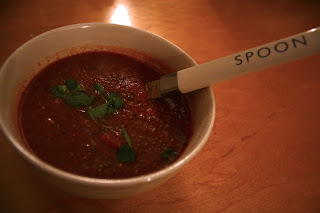
(yes, my spoon says SPOON. Just in case you were having difficulty figuring out what it was.)
Rich Tomato Soup
1 tbs butter
2 medium red onions, finely chopped
2 medium carrots, finely chopped
1-2 sticks celery, finely chopped
2 cloves garlic, minced
1/2-1 cup red cabbage, shredded (I forgot, this time around, that I used this initially -- soup still tasted good, but the cabbage did add an extra sweetness and also intensified the colour)
1/4 cup white wine (or 2 tbs sherry -- I am out of sherry at the moment)
2 tbs balsamic vinegar
2 cans (440g each) chopped tomatoes
1 can water
2 stock cubes + 2 tsp vegie spice (or use all one sort)
sea salt and freshly ground black pepper
Optional flavourings:
grated zest of 1/2 a lemon or lime
squeeze lemon/lime juice
1-2 tbs brandy or other spirit (+/- a dash extra to serve)
dash Tabasco
sprinkle of chopped coriander
Melt butter in a (preferably non-stick) saucepan over medium low heat; add onions, stir and leave to cook, covered, for about 5 min; add carrot, cook another 5 min; add celery and cabbage (if using) and continue to cook, covered, until vegetables begin to caramelize, another 10 min or so -- they will smell sweet, start to turn golden-brown and try to stick just a bit to the bottom of the pan. Add the garlic and let caramelization continue for about 5-10 min longer (if mixture is quite sticky then stir frequently; burnt garlic is never a good flavour!).
Splosh in the white wine or sherry and the vinegar and inhale the delicious smell rising from the pan. Add the tomatoes; dissolve the stock cubes/powder in hot water in the can, to rinse, and add to pan. Bring to a simmer for about 10 minutes to allow flavours to meld, then whiz gently with a stick blender (did I mention how much I love my hand blender?) until desired consistency -- I like mine without obvious pieces of vegetable remaining, but not completely homogeneous. Season with salt and black pepper to taste.
At this stage you can add the optional extra flavourings (highly recommended). The first time I used a bit of lime zest and juice stirred in at the end, and a dash of brandy in each bowl before serving up. The alcohol helps release the flavour in organic compounds, enhancing the richness and complexity of the soup -- well, that's the theory, anyway. My philosophy has always been that if you are generous with the drinks, guests never seem to complain about the quality of the food...
Today I was out of brandy (oops) and I wasn't sure whether Lee would approve of gin as a substitute (we are also out of vodka. It's been a tough couple of months) so I did two serving variations: Lee got a tiny bit of butter swirled into the soup to melt (to carry the fat-soluble flavours and enhance richness), and I tried out the gin option myself. I also used lemon zest and juice instead of lime (I do have a lime in the fridge, I just thought I'd do something different) and garnished both our bowls with a few coriander leaves. If I'd been braver (read: more certain it would work well) I would have sprinkled chopped coriander over the top -- it did work, as it turns out! And the gin was a success too (*hic*): I like my Bloody Marys made with gin, and the subtle juniper flavour also worked well here. Next time I'll be interested to Margaritise the recipe with tequila, lime and extra black pepper -- I bet the coriander would complement those flavours perfectly!
I don't know about the butter as I didn't try Lee's bowl, but there were no complaints. (And I didn't give him anything to drink, either.)
I don't, sadly, have the recipe for this incredible tart. (Though I am hoping to cajole Rachel into giving it to me at some point; stay tuned...) And that is why this is a post about soup.
When Lee requested tomato soup from scratch (rather than the usual Heinz classic) for dinner one night, a couple of months ago, I had to think about how I was going to make something that would taste like more than watered-down pasta sauce. I knew it had to be savoury and aromatic with a sweetness more complex than that produced just by adding sugar -- and my mind jumped, unbidden, back to the intense olfactory memory of those delectable caramelized onions: deliciously buttery, rich and sweet.
I had onions in the pantry and carrots and celery in the crisper, as is usual whenever the kitchen is active (i.e., not in Mother Hubbard mode); canned tomatoes in the cupboard; and an array of flavourings and seasonings to hand. I caramelized all the vegetables, resulting in added sweetness from the carrot as well as onion, cooked everything slowly to develop a rich flavour, and used some extra touches at the end to zing it up a bit. The result? Eminently satisfying.
Lee wanted tomato soup again tonight, so I took this opportunity to recreate the recipe and blog about it...

(yes, my spoon says SPOON. Just in case you were having difficulty figuring out what it was.)
Rich Tomato Soup
1 tbs butter
2 medium red onions, finely chopped
2 medium carrots, finely chopped
1-2 sticks celery, finely chopped
2 cloves garlic, minced
1/2-1 cup red cabbage, shredded (I forgot, this time around, that I used this initially -- soup still tasted good, but the cabbage did add an extra sweetness and also intensified the colour)
1/4 cup white wine (or 2 tbs sherry -- I am out of sherry at the moment)
2 tbs balsamic vinegar
2 cans (440g each) chopped tomatoes
1 can water
2 stock cubes + 2 tsp vegie spice (or use all one sort)
sea salt and freshly ground black pepper
Optional flavourings:
grated zest of 1/2 a lemon or lime
squeeze lemon/lime juice
1-2 tbs brandy or other spirit (+/- a dash extra to serve)
dash Tabasco
sprinkle of chopped coriander
Melt butter in a (preferably non-stick) saucepan over medium low heat; add onions, stir and leave to cook, covered, for about 5 min; add carrot, cook another 5 min; add celery and cabbage (if using) and continue to cook, covered, until vegetables begin to caramelize, another 10 min or so -- they will smell sweet, start to turn golden-brown and try to stick just a bit to the bottom of the pan. Add the garlic and let caramelization continue for about 5-10 min longer (if mixture is quite sticky then stir frequently; burnt garlic is never a good flavour!).
Splosh in the white wine or sherry and the vinegar and inhale the delicious smell rising from the pan. Add the tomatoes; dissolve the stock cubes/powder in hot water in the can, to rinse, and add to pan. Bring to a simmer for about 10 minutes to allow flavours to meld, then whiz gently with a stick blender (did I mention how much I love my hand blender?) until desired consistency -- I like mine without obvious pieces of vegetable remaining, but not completely homogeneous. Season with salt and black pepper to taste.
At this stage you can add the optional extra flavourings (highly recommended). The first time I used a bit of lime zest and juice stirred in at the end, and a dash of brandy in each bowl before serving up. The alcohol helps release the flavour in organic compounds, enhancing the richness and complexity of the soup -- well, that's the theory, anyway. My philosophy has always been that if you are generous with the drinks, guests never seem to complain about the quality of the food...
Today I was out of brandy (oops) and I wasn't sure whether Lee would approve of gin as a substitute (we are also out of vodka. It's been a tough couple of months) so I did two serving variations: Lee got a tiny bit of butter swirled into the soup to melt (to carry the fat-soluble flavours and enhance richness), and I tried out the gin option myself. I also used lemon zest and juice instead of lime (I do have a lime in the fridge, I just thought I'd do something different) and garnished both our bowls with a few coriander leaves. If I'd been braver (read: more certain it would work well) I would have sprinkled chopped coriander over the top -- it did work, as it turns out! And the gin was a success too (*hic*): I like my Bloody Marys made with gin, and the subtle juniper flavour also worked well here. Next time I'll be interested to Margaritise the recipe with tequila, lime and extra black pepper -- I bet the coriander would complement those flavours perfectly!
I don't know about the butter as I didn't try Lee's bowl, but there were no complaints. (And I didn't give him anything to drink, either.)
Monday, 5 March 2012
Slow-cooker vegetable lasagna
Lunch had to cook while we were out on our bike ride (from Timperley to town via the canal tow-path, a most scenic route and one which treated us to, among other things, the sight of two enormous white swans flying straight towards us down the canal just outside of Sale) and be ready for when we got in, tired and hungry and in need of sustenance. I thought initially of making lasagna and reheating it, but then it occurred to me to wonder whether it was possible to do it in the slow cooker so it would be hot and waiting for us. The internet said yes, and gave me the idea of using pesto and spinach as well.
I modified the recipe a fair bit, as I wanted more vegetables (the original called for just spinach and tomato pasta sauce), and a white sauce instead of ricotta. It turned out pretty well but could have used a touch more salt, in my opinion; next time I'll taste and season the vegetable sauce rather than just piling it all in and trusting to Dolmio! I also have no idea what quantity of lasagna noodles were required as I was using up various tag ends of boxes from the pantry and didn't keep count, but probably about 1-1.5 boxes would be plenty.
Lasagna noodles, some (see above)
200g packet spinach (that was how big they were at the shop; I could have used more)
about 1/2 small jar pesto
1.5 cups grated cheese
1/4 cup red wine
1/4 cup hot water
At some point while the sauces are cooking, put the slow cooker on to preheat (if required by instructions).
Vegetable sauce
large onion, chopped
2 cloves garlic, finely chopped
2 medium carrots, chopped
1-2 stalks celery, chopped
1/2 red pepper and 1/2 yellow pepper (one guest didn't like green pepper), chopped
200g mushrooms, sliced (cut in half first if large)
2 x 300g jars tomato pasta sauce (this is totally cheating and you can of course use canned tomatoes and add extra herbs and seasoning!)
1/4 cup red wine
salt and freshly ground black pepper
Heat a small amount of oil in a large pan and fry onion, garlic, carrots, celery and pepper (adding each to pan as it is chopped); add mushrooms and pasta sauce; rinse jars with red wine and add to pan. Simmer until vegetables are cooked; season to taste.
White sauce
30g butter
1 heaped tbs plain flour
500ml milk
salt and pepper
Melt butter over medium heat, stir in flour, cook for a couple of minutes. Remove from heat, add milk gradually, whisking to incorporate until a smooth mixture is formed. Return to heat and cook, whisking constantly, until thickened and just at a boil; allow to cook a couple more minutes. Season with salt and pepper.
To assemble:
Put a thin layer of vegetable sauce in the base of the slow cooker; spread pesto over lasagna sheets and use to cover sauce. Layer vegetable sauce, spinach, white sauce and more pesto-spread lasagna sheets; vegetable sauce, spinach, half the cheese and lasagna sheets; vegetable sauce, spinach and lasagna; and vegetable sauce, white sauce and remaining cheese. Or, you know, whatever combination suits the amounts of ingredients you have...
Rinse out vegetable sauce pan with remaining wine and water, pour over everything in the slow cooker. Shut the lid and cook on high for about 3-4 hours. Ours was perfect at 3:30, having gone in at 11:30, and would probably have been fine sooner -- but would also probably have benefited from being removed from the heat and let stand for a little while to firm up. Even so, it was heartily satisfying, rich and tasty without any hard dry bits, but with a decent browned crust. Leftovers tasted even better the next day!
Preparation time: about an hour to make sauces and assemble, plus 3-4 hours slow cooker time
Makes: Enough for four hungry people post-bike ride, plus enough left over to freeze a box and have three small meals the next day -- probably serves 6-8, the former very generously, the latter quite adequately.
I modified the recipe a fair bit, as I wanted more vegetables (the original called for just spinach and tomato pasta sauce), and a white sauce instead of ricotta. It turned out pretty well but could have used a touch more salt, in my opinion; next time I'll taste and season the vegetable sauce rather than just piling it all in and trusting to Dolmio! I also have no idea what quantity of lasagna noodles were required as I was using up various tag ends of boxes from the pantry and didn't keep count, but probably about 1-1.5 boxes would be plenty.
Lasagna noodles, some (see above)
200g packet spinach (that was how big they were at the shop; I could have used more)
about 1/2 small jar pesto
1.5 cups grated cheese
1/4 cup red wine
1/4 cup hot water
At some point while the sauces are cooking, put the slow cooker on to preheat (if required by instructions).
Vegetable sauce
large onion, chopped
2 cloves garlic, finely chopped
2 medium carrots, chopped
1-2 stalks celery, chopped
1/2 red pepper and 1/2 yellow pepper (one guest didn't like green pepper), chopped
200g mushrooms, sliced (cut in half first if large)
2 x 300g jars tomato pasta sauce (this is totally cheating and you can of course use canned tomatoes and add extra herbs and seasoning!)
1/4 cup red wine
salt and freshly ground black pepper
Heat a small amount of oil in a large pan and fry onion, garlic, carrots, celery and pepper (adding each to pan as it is chopped); add mushrooms and pasta sauce; rinse jars with red wine and add to pan. Simmer until vegetables are cooked; season to taste.
White sauce
30g butter
1 heaped tbs plain flour
500ml milk
salt and pepper
Melt butter over medium heat, stir in flour, cook for a couple of minutes. Remove from heat, add milk gradually, whisking to incorporate until a smooth mixture is formed. Return to heat and cook, whisking constantly, until thickened and just at a boil; allow to cook a couple more minutes. Season with salt and pepper.
To assemble:
Put a thin layer of vegetable sauce in the base of the slow cooker; spread pesto over lasagna sheets and use to cover sauce. Layer vegetable sauce, spinach, white sauce and more pesto-spread lasagna sheets; vegetable sauce, spinach, half the cheese and lasagna sheets; vegetable sauce, spinach and lasagna; and vegetable sauce, white sauce and remaining cheese. Or, you know, whatever combination suits the amounts of ingredients you have...
Rinse out vegetable sauce pan with remaining wine and water, pour over everything in the slow cooker. Shut the lid and cook on high for about 3-4 hours. Ours was perfect at 3:30, having gone in at 11:30, and would probably have been fine sooner -- but would also probably have benefited from being removed from the heat and let stand for a little while to firm up. Even so, it was heartily satisfying, rich and tasty without any hard dry bits, but with a decent browned crust. Leftovers tasted even better the next day!
Preparation time: about an hour to make sauces and assemble, plus 3-4 hours slow cooker time
Makes: Enough for four hungry people post-bike ride, plus enough left over to freeze a box and have three small meals the next day -- probably serves 6-8, the former very generously, the latter quite adequately.
A day of cooking!
Last Saturday I somehow ended up having arranged to have two different groups of people over for lunch and dinner respectively. While you might think that this would result in economies of scale such that it would have been possible to save time by serving both groups the same food, my desire for culinary adventure (wanting to try new recipes and not wanting to eat the same meal twice in one day myself) and the dietary preferences of my different friends (one group vegetarian and not into spicy food, the other containing at least one dedicated carnivore and a few chilli-heads) made this less of an option. Combine that with a slight hangover, a morning visitor, a plan to go out for a bike ride for several hours during the day and a kitchen still resembling a bomb site from recent fridge installation and it could have been a disaster requiring dial-a-pizza -- in fact I'm still not quite sure how it wasn't, but instead we had two fairly successful, tasty and varied meals!
For lunch I made:
Sweet potato, ginger and coconut soup (vegetarian, non-spicy version)
Slow-cooker vegetable lasagna
plus garlic bread
For dinner:
Spring rolls and vegetable wontons (a cheat as these came out of frozen packets from the Chinese shop)
Sichuan belly pork with chilli sauce (based on this recipe from The Grubworm)
Fish-fragrant spicy aubergine (based on this recipe from Hollow Legs, but with minced pork)
Tofu with Thai three-flavour sauce (recipe from SheSimmers)
Crispy orange chicken (a combination of the Orange chicken from No Recipes and the Serious Eats orange-peel shrimp recipe)
and, as it turns out, for probably the first time in the history of the universe, Not Enough Rice. But that's ok, because there was plenty of other food and chocolate cake for dessert!
All in all a successful food venture, though less successful as far as food blogging goes, since as usual I forgot to take any pictures!
Recipes to follow shortly...
For lunch I made:
Sweet potato, ginger and coconut soup (vegetarian, non-spicy version)
Slow-cooker vegetable lasagna
plus garlic bread
For dinner:
Spring rolls and vegetable wontons (a cheat as these came out of frozen packets from the Chinese shop)
Sichuan belly pork with chilli sauce (based on this recipe from The Grubworm)
Fish-fragrant spicy aubergine (based on this recipe from Hollow Legs, but with minced pork)
Tofu with Thai three-flavour sauce (recipe from SheSimmers)
Crispy orange chicken (a combination of the Orange chicken from No Recipes and the Serious Eats orange-peel shrimp recipe)
and, as it turns out, for probably the first time in the history of the universe, Not Enough Rice. But that's ok, because there was plenty of other food and chocolate cake for dessert!
All in all a successful food venture, though less successful as far as food blogging goes, since as usual I forgot to take any pictures!
Recipes to follow shortly...
Monday, 27 February 2012
Mother Hubbard's caramel slice
Partly due to the exigencies of daily life (such as shortage of time to go shopping and shortage of money to go shopping with), partly due to the chaotic state of the pantry and partly due to the fact that we have just got a new fridge and don't want to fill it straight up with all the old (and I mean old; there's a bag of potatoes which recently celebrated their first birthday, a container of frozen peanut sauce from 2008 and a jar of senapsill in there dated best-before 2007...) crap stuff from our previous fridge, we have been having a Mother Hubbard month, which is where you try to use up things from your cupboard (and fridge and freezer) rather than buying new food. It's amazing what you can make without having to go shopping at all! Or perhaps it's just amazing how much random food I seem to accumulate in the pantry. During the Manchester riots last year, I made some last-minute 'zombie survival' plans and calculated that we had over a month's worth of food on hand without even trying.
This is fine for regular meals on my own, when baked beans served over pasta, or miso soup noodles with cabbage and an egg three nights in a row, are perfectly reasonable food choices; I've also revisited, with more than a touch of nostalgia, the old standby of my student days -- HP sauce and mayonnaise on crackers. These ingredients aren't only for trashy-food combos, either: Shrove Tuesday dinner was pancakes (made without milk, a recipe worth recording as we never seem to have any milk) served Japanese-style as a main course, wrapped with cabbage and egg and drizzled with (yup) HP sauce and mayonnaise; then with lemon and sugar, or strawberry jam and chocolate, for dessert.
But it doesn't really seem fair to inflict my HPSM fetish on others, when making food to share -- so what can one make, when the cupboard is bare? Answer: caramel slice.

This is sometimes called "millionaire's shortbread"; I've no idea why, as the ingredients are dead cheap! Unless perhaps you manage to save so much money on food during Mother-Hubbard months that you end up extremely rich. I'm still hoping...
Caramel Slice
Base:
100g butter
2/3 cup SR flour
1/3 cup plain flour
1/2 cup brown sugar
2/3 cup coconut
Caramel:
1 can (397g) condensed milk
2 heaped tbs golden syrup
30g butter
Topping:
150g dark chocolate
Preheat oven to 180C. Melt butter; sift in flours and sugar and add coconut. Mix all together until well blended. Press mixture into a lined tray (I used one about 18 x 25cm) and bake for about 15 minutes or until golden brown. Set aside to cool for about 10 minutes.
Meanwhile make caramel: add all ingredients to a small saucepan and cook over medium heat, whisking, until caramel is a nice light brown colour and seems a bit thicker.
Pour caramel over base and return to oven; cook for about 15 minutes until caramel is a deeper brown on top and is just set. Cool for a couple of hours.
Melt chocolate and spread over top of caramel; make swirly patterns with a knife if you want to be artistic! Cut into squares or slices when cool.
Makes about 30 pieces (2 inches square).
(Based on recipes from Butter Sugar Flour and taste.com.au)
Pancakes for people who never have any milk
Google was my friend and helped me to find this handy link; I halved the recipe, reduced the amount of baking powder and added a splash more water because I wanted pancake-thickness rather than pikelet-thickness, cooked some of them and then added another splash of water to make crepe-thickness ones for dessert.
1 cup plain flour
1 tsp baking powder
pinch salt
1 tbs sugar
1 cup water
1 tbs oil
1 egg
Sift dry ingredients into a bowl; make a well in the middle. Whisk together wet ingredients, pour into well, mix in dry ingredients gradually with whisk. Adjust to desired consistency (double pouring cream for pancakes, single pouring cream for crepes); leave to stand 10 min.
Meanwhile (if you have an electric stove like me) turn stove to medium so that it has reached a nice consistent temperature by the time you're ready to cook. For each pancake, add a little dab of butter to the pan, melt and swirl round pan, then add a serving-spoonful of batter (amount depends on desired thickness and heat of pan), tilt pan to spread, and cook until lightly browned on each side.
Made 6 pancakes and 4 crepes, 18cm diameter.
This is fine for regular meals on my own, when baked beans served over pasta, or miso soup noodles with cabbage and an egg three nights in a row, are perfectly reasonable food choices; I've also revisited, with more than a touch of nostalgia, the old standby of my student days -- HP sauce and mayonnaise on crackers. These ingredients aren't only for trashy-food combos, either: Shrove Tuesday dinner was pancakes (made without milk, a recipe worth recording as we never seem to have any milk) served Japanese-style as a main course, wrapped with cabbage and egg and drizzled with (yup) HP sauce and mayonnaise; then with lemon and sugar, or strawberry jam and chocolate, for dessert.
But it doesn't really seem fair to inflict my HPSM fetish on others, when making food to share -- so what can one make, when the cupboard is bare? Answer: caramel slice.

This is sometimes called "millionaire's shortbread"; I've no idea why, as the ingredients are dead cheap! Unless perhaps you manage to save so much money on food during Mother-Hubbard months that you end up extremely rich. I'm still hoping...
Caramel Slice
Base:
100g butter
2/3 cup SR flour
1/3 cup plain flour
1/2 cup brown sugar
2/3 cup coconut
Caramel:
1 can (397g) condensed milk
2 heaped tbs golden syrup
30g butter
Topping:
150g dark chocolate
Preheat oven to 180C. Melt butter; sift in flours and sugar and add coconut. Mix all together until well blended. Press mixture into a lined tray (I used one about 18 x 25cm) and bake for about 15 minutes or until golden brown. Set aside to cool for about 10 minutes.
Meanwhile make caramel: add all ingredients to a small saucepan and cook over medium heat, whisking, until caramel is a nice light brown colour and seems a bit thicker.
Pour caramel over base and return to oven; cook for about 15 minutes until caramel is a deeper brown on top and is just set. Cool for a couple of hours.
Melt chocolate and spread over top of caramel; make swirly patterns with a knife if you want to be artistic! Cut into squares or slices when cool.
Makes about 30 pieces (2 inches square).
(Based on recipes from Butter Sugar Flour and taste.com.au)
Pancakes for people who never have any milk
Google was my friend and helped me to find this handy link; I halved the recipe, reduced the amount of baking powder and added a splash more water because I wanted pancake-thickness rather than pikelet-thickness, cooked some of them and then added another splash of water to make crepe-thickness ones for dessert.
1 cup plain flour
1 tsp baking powder
pinch salt
1 tbs sugar
1 cup water
1 tbs oil
1 egg
Sift dry ingredients into a bowl; make a well in the middle. Whisk together wet ingredients, pour into well, mix in dry ingredients gradually with whisk. Adjust to desired consistency (double pouring cream for pancakes, single pouring cream for crepes); leave to stand 10 min.
Meanwhile (if you have an electric stove like me) turn stove to medium so that it has reached a nice consistent temperature by the time you're ready to cook. For each pancake, add a little dab of butter to the pan, melt and swirl round pan, then add a serving-spoonful of batter (amount depends on desired thickness and heat of pan), tilt pan to spread, and cook until lightly browned on each side.
Made 6 pancakes and 4 crepes, 18cm diameter.
Monday, 13 February 2012
How big is an egg?
(Or, "A mousse once bit my sister...")
No, it's not like "How long is a piece of string?" or other such silly questions. The eggs I used to buy in Australia were usually what was called 'jumbo', and they were 67g. The eggs I buy here are labelled 'large', don't have a weight grading on them, but seem considerably smaller; I think they're probably 55g. The eggs called for in recipes often don't have a specified size at all, or if they do it's something like 'medium', which is not really much use.
This lack of technical information suddenly became relevant this weekend, when I was asked to three separate meals at friends' houses and offered to make dessert for two of them (I had to say I'd bring a starter for the middle one, just to avoid pudding fatigue). Dinner One was a Friday night pasta meal for three, so dessert had to be something quick to make, not too large and not too heavy; Dinner Three was a proper Sunday roast out in the country, requiring a suitably lavish finale that could be transported easily by train. The solution to both? Mousse.
The first recipe on the second hit when you Google 'easy lemon dessert' is, sure enough, an easy lemon dessert recipe (I admit that the 'easy' and 'lemon' parts were what sold me on the idea, along with the fact that it only required five ingredients; the mousse theme emerged later). So that was Friday sorted. I thought something like a chocolate raspberry mousse would be just the thing for Sunday, and after looking through a few recipes, decided on this one (possibly seduced just a little myself by the accompanying prose testimonial).
And this is where I encountered my small problem. Both these recipes call for eggs, the first cooked into a sort of custard before folding in whipped cream, the second separated, with the whites whisked (I assumed until they formed stiff peaks, and this seemed to be successful). In each case, the quantity of egg is obviously somewhat important to the texture of the finished product; too little egg-to-liquid in the custard or too much egg-to-chocolate-and-cream will both result in runny mousse -- never a good thing, especially when you are transporting your creations on trains and buses. So what size eggs did CM mean? And what sort of 'jumbo' eggs did Mr Hulles use to make his "favorite dessert ever" -- Australian jumbo, American jumbo or some other size? If they were 67g, then '3 jumbo eggs' is 201g of egg -- the equivalent of nearly 4 of my 55g eggs (assuming that's what size they even are).
In the end, I guesstimated and adjusted quantities based not only on approximate egg size but on the feel of the ingredients and the packet size of the other ingredients -- for example, both these recipes call for 1 cup (and is that an American or a British/Australian cup? And as for tablespoons, let's not even go there) of cream, but cream here comes in 284ml (Aldi) or 300ml (Sainsbury's; Aldi was out of stock when I went back for the second batch of cream, grr) pots, and I know if I have 34ml of cream left in the fridge it's just going to go off, so may as well use the whole lot. It seemed to work -- at least, there were no complaints!
Here are my versions of the recipes.
Light lemon mousse (serves 4-6)
3 eggs
1 cup sugar
zest and juice of two lemons
284ml double cream
1 tsp vanilla
1 tbs icing sugar
2 tbs Limoncello
5 digestive biscuits, squashed
Beat together eggs, sugar, lemon zest and juice. Cook in double boiler (or right on the stove if you're brave; I used a Pyrex set over a saucepan, with the bottom of the bowl submerged in the water), whisking/stirring constantly until fairly thick -- the whisk should leave distinct trails behind it. I'd probably add the Limoncello at this point; when I made this it was a last-minute addition, so I sloshed it in at the end, then was worried I'd added too much and it was going to make the whole thing collapse and liquefy; luckily this didn't happen, but even so...
Whip the cream; fold into the lemon mixture. Put a layer of squashed biscuit in the bottom of 4-6 serving glasses or cups, leaving a handful for garnish; divide the lemon mousse between the cups and sprinkle with leftover biscuit crumbs to decorate.
Preparation time: I got home at 6pm and was out the door with this all made and packed plus a box of strawberries hand-dipped in chocolate by 6:45. Not bad going.
Chocolate raspberry mousse cake (makes a 22cm cake about 2.5 inches high)
~1 3/4 cups raspberries (about 3/4 of a 300g pack, leaving a handful or so to garnish)
1/4 cup sugar
2 tbs Amaretto (I would have used Chambord but didn't have any)
300g chocolate
60g butter
4 eggs, separated
300ml double cream
10 digestive biscuits, squashed
Extra raspberries, white and dark chocolate shavings to garnish
Squash raspberries with a fork and macerate with sugar and liqueur for a while (I left them overnight because I started making this and then ran out of time and had to go to Dinner Two, along with my vegetarian antipasto selection of beetroot dip, teriyaki mushrooms and lemon-chilli fried halloumi). Melt chocolate (2 minutes in the microwave worked perfectly) and stir in butter until smooth. Stir egg yolks into raspberry mixture. Whisk egg whites until they form stiff peaks; whip cream (don't make it too stiff or it will be hard to fold in, as I discovered). Make sure chocolate mixture isn't too hot, then stir in raspberry mixture all at once. (The italics are from the original recipe. Why 'all at once'? I don't know for sure because I didn't try doing it any other way, but I'm guessing it's to avoid the possibility that the chocolate mixture might seize.) Fold in cream until well combined, then fold in egg whites in two batches.
You could just serve this in glasses or a big serving bowl, but I made a crumb base with the squashed digestives and another spoonful or so of Amaretto (just enough to make the mix damp) and spooned the mousse on top to make it into a cake. After a few hours in the fridge, the mousse should have set firm enough to hold its shape reasonably well when sliced. Dot any extra raspberries around artistically and shave white and dark chocolate curls off the block with a potato peeler, straight onto the top.
Preparation time: about 40 minutes this time round, but I think it'd be faster now I know what I'm doing.
No, it's not like "How long is a piece of string?" or other such silly questions. The eggs I used to buy in Australia were usually what was called 'jumbo', and they were 67g. The eggs I buy here are labelled 'large', don't have a weight grading on them, but seem considerably smaller; I think they're probably 55g. The eggs called for in recipes often don't have a specified size at all, or if they do it's something like 'medium', which is not really much use.
This lack of technical information suddenly became relevant this weekend, when I was asked to three separate meals at friends' houses and offered to make dessert for two of them (I had to say I'd bring a starter for the middle one, just to avoid pudding fatigue). Dinner One was a Friday night pasta meal for three, so dessert had to be something quick to make, not too large and not too heavy; Dinner Three was a proper Sunday roast out in the country, requiring a suitably lavish finale that could be transported easily by train. The solution to both? Mousse.
The first recipe on the second hit when you Google 'easy lemon dessert' is, sure enough, an easy lemon dessert recipe (I admit that the 'easy' and 'lemon' parts were what sold me on the idea, along with the fact that it only required five ingredients; the mousse theme emerged later). So that was Friday sorted. I thought something like a chocolate raspberry mousse would be just the thing for Sunday, and after looking through a few recipes, decided on this one (possibly seduced just a little myself by the accompanying prose testimonial).
And this is where I encountered my small problem. Both these recipes call for eggs, the first cooked into a sort of custard before folding in whipped cream, the second separated, with the whites whisked (I assumed until they formed stiff peaks, and this seemed to be successful). In each case, the quantity of egg is obviously somewhat important to the texture of the finished product; too little egg-to-liquid in the custard or too much egg-to-chocolate-and-cream will both result in runny mousse -- never a good thing, especially when you are transporting your creations on trains and buses. So what size eggs did CM mean? And what sort of 'jumbo' eggs did Mr Hulles use to make his "favorite dessert ever" -- Australian jumbo, American jumbo or some other size? If they were 67g, then '3 jumbo eggs' is 201g of egg -- the equivalent of nearly 4 of my 55g eggs (assuming that's what size they even are).
In the end, I guesstimated and adjusted quantities based not only on approximate egg size but on the feel of the ingredients and the packet size of the other ingredients -- for example, both these recipes call for 1 cup (and is that an American or a British/Australian cup? And as for tablespoons, let's not even go there) of cream, but cream here comes in 284ml (Aldi) or 300ml (Sainsbury's; Aldi was out of stock when I went back for the second batch of cream, grr) pots, and I know if I have 34ml of cream left in the fridge it's just going to go off, so may as well use the whole lot. It seemed to work -- at least, there were no complaints!
Here are my versions of the recipes.
Light lemon mousse (serves 4-6)
3 eggs
1 cup sugar
zest and juice of two lemons
284ml double cream
1 tsp vanilla
1 tbs icing sugar
2 tbs Limoncello
5 digestive biscuits, squashed
Beat together eggs, sugar, lemon zest and juice. Cook in double boiler (or right on the stove if you're brave; I used a Pyrex set over a saucepan, with the bottom of the bowl submerged in the water), whisking/stirring constantly until fairly thick -- the whisk should leave distinct trails behind it. I'd probably add the Limoncello at this point; when I made this it was a last-minute addition, so I sloshed it in at the end, then was worried I'd added too much and it was going to make the whole thing collapse and liquefy; luckily this didn't happen, but even so...
Whip the cream; fold into the lemon mixture. Put a layer of squashed biscuit in the bottom of 4-6 serving glasses or cups, leaving a handful for garnish; divide the lemon mousse between the cups and sprinkle with leftover biscuit crumbs to decorate.
Preparation time: I got home at 6pm and was out the door with this all made and packed plus a box of strawberries hand-dipped in chocolate by 6:45. Not bad going.
Chocolate raspberry mousse cake (makes a 22cm cake about 2.5 inches high)
~1 3/4 cups raspberries (about 3/4 of a 300g pack, leaving a handful or so to garnish)
1/4 cup sugar
2 tbs Amaretto (I would have used Chambord but didn't have any)
300g chocolate
60g butter
4 eggs, separated
300ml double cream
10 digestive biscuits, squashed
Extra raspberries, white and dark chocolate shavings to garnish
Squash raspberries with a fork and macerate with sugar and liqueur for a while (I left them overnight because I started making this and then ran out of time and had to go to Dinner Two, along with my vegetarian antipasto selection of beetroot dip, teriyaki mushrooms and lemon-chilli fried halloumi). Melt chocolate (2 minutes in the microwave worked perfectly) and stir in butter until smooth. Stir egg yolks into raspberry mixture. Whisk egg whites until they form stiff peaks; whip cream (don't make it too stiff or it will be hard to fold in, as I discovered). Make sure chocolate mixture isn't too hot, then stir in raspberry mixture all at once. (The italics are from the original recipe. Why 'all at once'? I don't know for sure because I didn't try doing it any other way, but I'm guessing it's to avoid the possibility that the chocolate mixture might seize.) Fold in cream until well combined, then fold in egg whites in two batches.
You could just serve this in glasses or a big serving bowl, but I made a crumb base with the squashed digestives and another spoonful or so of Amaretto (just enough to make the mix damp) and spooned the mousse on top to make it into a cake. After a few hours in the fridge, the mousse should have set firm enough to hold its shape reasonably well when sliced. Dot any extra raspberries around artistically and shave white and dark chocolate curls off the block with a potato peeler, straight onto the top.
Preparation time: about 40 minutes this time round, but I think it'd be faster now I know what I'm doing.
Wednesday, 15 June 2011
Recent cooking exploits
I am a terrible food blogger. Not because I don't post very often (though I don't), or because my recipes are awful (I don't post the awful ones!), or because my writing is dreadful (I like to think it's ok, most of the time, and at least I can spell and use correct grammar), but because I always forget to take photos. By the time I have chopped, cooked, prepared and served, I'm usually too hungry (or my guests are!) to remember to get the camera out. And then I think of doing a blog post about my cooking adventures, and then I think "If only I'd taken a photo!". And then I don't post after all.
But since the point of this blog was partly to record recipes for my own use, I figure I may as well put them down, even if there are no pretty pictures to whet the appetite.
A couple of weeks ago I had friends round for the evening and decided to do a tapas-style spread with a variety of dishes and platters for everyone to pick at. One of my favourite restaurants in Manchester is Dimitri's, which sounds Greek but describes itself as a "tapas taverna"; and one of the dishes we often have there is chorizos bravas -- like patatas bravas but with added chorizo. Inspired by this, I set out to make my own version.
I wanted something more tomatoey and less oily, so this is more like a chorizo and potato stew than real patatas bravas, which never have enough of the tomato sauce for my liking. Far from the source it may be, but this came out so well I felt I should write it down for next time. Another thing I liked is that the proportions came out perfectly using whole packs of things -- no little bits or half-packets left over!
Spicy chorizo and potato stew
1kg new/salad potatoes
2 x 170g spicy chorizo rings, cut into 1cm slices
2 red onions, roughly chopped
4 cloves garlic, crushed/finely chopped
2 capsicums (peppers) - whatever colour, mixed is good - roughly chopped
1/2 cup red wine
1 cup prepared tomato sauce (we had half a jar of Dolmio in the fridge; using a can of crushed tomatoes and adding extra seasoning would probably work just fine)
freshly ground black pepper
squeeze of fresh lemon
couple of handfuls sliced spring onion
Boil potatoes whole for about 10 minutes, until tender but not squishy. Let cool, then slice thickly (about 1.5cm slices).
Heat heavy-based pan on medium and fry chorizo slices on both sides until browned; remove from pan. Add onions, garlic and capsicum to pan and fry (in oil released from chorizo) for a few minutes, until slightly softened. Add potato slices and cook for a few minutes each side until slightly browned. Return chorizo to pan, add wine and tomato sauce/tomatoes, season with freshly ground black pepper, cook about 10 minutes until sauce is slightly thickened. Add an extra grinding of pepper, a squeeze of lemon and sliced spring onions, and serve with crusty bread.
(Next time I make this I will probably add one or two sliced red chillies along with the onion, peppers and garlic; the chorizo wasn't really spicy enough for my taste.)
But since the point of this blog was partly to record recipes for my own use, I figure I may as well put them down, even if there are no pretty pictures to whet the appetite.
A couple of weeks ago I had friends round for the evening and decided to do a tapas-style spread with a variety of dishes and platters for everyone to pick at. One of my favourite restaurants in Manchester is Dimitri's, which sounds Greek but describes itself as a "tapas taverna"; and one of the dishes we often have there is chorizos bravas -- like patatas bravas but with added chorizo. Inspired by this, I set out to make my own version.
I wanted something more tomatoey and less oily, so this is more like a chorizo and potato stew than real patatas bravas, which never have enough of the tomato sauce for my liking. Far from the source it may be, but this came out so well I felt I should write it down for next time. Another thing I liked is that the proportions came out perfectly using whole packs of things -- no little bits or half-packets left over!
Spicy chorizo and potato stew
1kg new/salad potatoes
2 x 170g spicy chorizo rings, cut into 1cm slices
2 red onions, roughly chopped
4 cloves garlic, crushed/finely chopped
2 capsicums (peppers) - whatever colour, mixed is good - roughly chopped
1/2 cup red wine
1 cup prepared tomato sauce (we had half a jar of Dolmio in the fridge; using a can of crushed tomatoes and adding extra seasoning would probably work just fine)
freshly ground black pepper
squeeze of fresh lemon
couple of handfuls sliced spring onion
Boil potatoes whole for about 10 minutes, until tender but not squishy. Let cool, then slice thickly (about 1.5cm slices).
Heat heavy-based pan on medium and fry chorizo slices on both sides until browned; remove from pan. Add onions, garlic and capsicum to pan and fry (in oil released from chorizo) for a few minutes, until slightly softened. Add potato slices and cook for a few minutes each side until slightly browned. Return chorizo to pan, add wine and tomato sauce/tomatoes, season with freshly ground black pepper, cook about 10 minutes until sauce is slightly thickened. Add an extra grinding of pepper, a squeeze of lemon and sliced spring onions, and serve with crusty bread.
(Next time I make this I will probably add one or two sliced red chillies along with the onion, peppers and garlic; the chorizo wasn't really spicy enough for my taste.)
Subscribe to:
Posts (Atom)